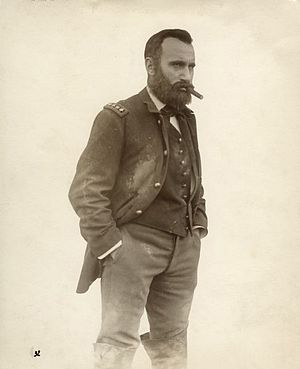
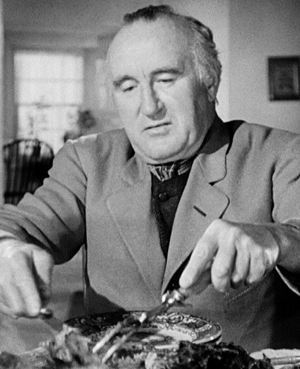
| Donald
Crisp won
the Best Supporting Actor for his sensitive performance in How Green Was My Valley in 1941,
26 years after playing Ulysses S. Grant in Birth of a Nation.
Crisp was a stalwart member of Griffith's stock company, most
notably for his performance in Broken Blossoms (1919). He is best
remembered today for his performances in Wuthering Heights (1939)
and National Velvet (1945). He also had a successful directing career
in the silents, helming such classics as Buster Keaton's The Navigator (1924)
and Douglas Fairbanks' Don Q., Son of Zorro (1925).
The
reputation of Birth of a Nation has diminished considerably
in recent years because of its shockingly racist storyline, although
it is considered the first American feature film. The racism of the film
did not go
unnoticed by its contemporary audience (the newly-formed NAACP
campaigned to have it banned, and was successful in some cities
including Los Angeles), but it was a financial blockbuster
that launched many successful careers; most notably
directors John Ford (who appeared as a Klansman in the film) and
Raoul Walsh (who played John Wilkes Booth) and of course
Lillian Gish (who went on to become arguably the greatest
actress in the history of motion pictures).
 By
the time the Oscars were initiated, Griffith's career had petered
out to the point he was never nominated (he was credited as the
director on only four films that were eligible for Academy Awards,
failing to receive a single nomination in any category; although
his penultimate film, Abraham Lincoln, was named one of the
ten best films of 1930 by the New York Times). Had the Oscars been
awarded earlier, it seems inconceivable that he wouldn't have won
for both Broken Blossoms (1919) and Way Down East
(1920) and received nominations for Hearts of the World (1918)
and Orphans of the Storm (1921). He did receive an Honorary
Oscar in 1935, and earned the first standing ovation in Oscar history
when he accepted it. He unquestionably would have swept the awards with Birth of a Nation, in part because he would have had virtually no competition for the prize. It is fashionable to dismiss Griffith's contribution to the evolution of film now by saying that his advances would have been achieved by someone if he hadn't come along. But most people don't consider the fact that the film business was almost inconceivably different than what it is today and that Griffith's epic was considered to be a monumental folly that frequently teetered on the verge of financial collapse when it was being produced. If it had failed with audiences, the film business would have very likely gone in a different direction than it did. But because Birth of a Nation was the colossal success that it was, other producers jumped on the feature film bandwagon. Griffith's influence cannot be overstated. By
the time the Oscars were initiated, Griffith's career had petered
out to the point he was never nominated (he was credited as the
director on only four films that were eligible for Academy Awards,
failing to receive a single nomination in any category; although
his penultimate film, Abraham Lincoln, was named one of the
ten best films of 1930 by the New York Times). Had the Oscars been
awarded earlier, it seems inconceivable that he wouldn't have won
for both Broken Blossoms (1919) and Way Down East
(1920) and received nominations for Hearts of the World (1918)
and Orphans of the Storm (1921). He did receive an Honorary
Oscar in 1935, and earned the first standing ovation in Oscar history
when he accepted it. He unquestionably would have swept the awards with Birth of a Nation, in part because he would have had virtually no competition for the prize. It is fashionable to dismiss Griffith's contribution to the evolution of film now by saying that his advances would have been achieved by someone if he hadn't come along. But most people don't consider the fact that the film business was almost inconceivably different than what it is today and that Griffith's epic was considered to be a monumental folly that frequently teetered on the verge of financial collapse when it was being produced. If it had failed with audiences, the film business would have very likely gone in a different direction than it did. But because Birth of a Nation was the colossal success that it was, other producers jumped on the feature film bandwagon. Griffith's influence cannot be overstated.
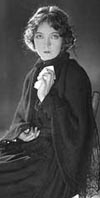 Lillian Gish
received only one Academy Award nomination (for Duel in the
Sun, 1946). Her greatest work was in the pre-Oscar period
(Broken Blossoms, 1919; Way Down East, 1920; Orphans of the Storm, 1922; La
Boheme, 1925; The Scarlet Letter, 1926), although her
failure to be nominated for The Wind (1928) seems inexplicable
today. After her film stardom had diminished, she continued to
have a successful career on stage (Yelena Andreyevna in Uncle Vanya in 1930, the title role in Camille in 1932, Ophelia to John Gielgud's Hamlet
in 1936) and as a character actress on film (Night of the Hunter,
1955) and on television (The Trip to Bountiful, 1953).
She received an Honorary Oscar in 1970, and made her final starring
performance in a motion picture at the age of 94. She credited Griffith with her success to the end of her life, and titled her autobiography The Movies, Mr. Griffith, and Me. Lillian Gish
received only one Academy Award nomination (for Duel in the
Sun, 1946). Her greatest work was in the pre-Oscar period
(Broken Blossoms, 1919; Way Down East, 1920; Orphans of the Storm, 1922; La
Boheme, 1925; The Scarlet Letter, 1926), although her
failure to be nominated for The Wind (1928) seems inexplicable
today. After her film stardom had diminished, she continued to
have a successful career on stage (Yelena Andreyevna in Uncle Vanya in 1930, the title role in Camille in 1932, Ophelia to John Gielgud's Hamlet
in 1936) and as a character actress on film (Night of the Hunter,
1955) and on television (The Trip to Bountiful, 1953).
She received an Honorary Oscar in 1970, and made her final starring
performance in a motion picture at the age of 94. She credited Griffith with her success to the end of her life, and titled her autobiography The Movies, Mr. Griffith, and Me.
|