
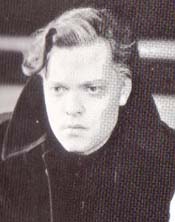
 Orson
Welles (1915-1985) is so famous for his 1938 radio broadcast of The War
of the Worlds and films like Citizen Kane (1941), The Lady from
Shanghai (1947), The Third Man (1949), and A Man for All Seasons
(1966) that it is easy to forget that he was not only a highly regarded actor
and director for the stage long before his movie success, but he continued to
do important work in the theatre for decades afterwards. He had a long career
in Shakespeare, playing Cassius in Julius Caesar in a 1928 school production
and quickly graduating to the Ghost and Fortinbras in Hamlet at the Gate
Theatre in Dublin in 1931 at the age of 16 and Malvolio in Twelfth Night
the following year. He made his Broadway debut as Tybalt in Romeo and Juliet
with Katharine Cornell in 1934 and then returned to the Gate Theatre to play
Claudius in Hamlet opposite Micheál MacLiammóir as the
young Prince of Denmark, who was 16 years older than Welles.
Orson
Welles (1915-1985) is so famous for his 1938 radio broadcast of The War
of the Worlds and films like Citizen Kane (1941), The Lady from
Shanghai (1947), The Third Man (1949), and A Man for All Seasons
(1966) that it is easy to forget that he was not only a highly regarded actor
and director for the stage long before his movie success, but he continued to
do important work in the theatre for decades afterwards. He had a long career
in Shakespeare, playing Cassius in Julius Caesar in a 1928 school production
and quickly graduating to the Ghost and Fortinbras in Hamlet at the Gate
Theatre in Dublin in 1931 at the age of 16 and Malvolio in Twelfth Night
the following year. He made his Broadway debut as Tybalt in Romeo and Juliet
with Katharine Cornell in 1934 and then returned to the Gate Theatre to play
Claudius in Hamlet opposite Micheál MacLiammóir as the
young Prince of Denmark, who was 16 years older than Welles.
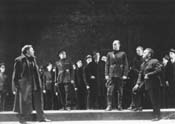 The
Federal Theatre Project was launched in 1936 and producer John Houseman invited
Welles to be his partner at the Lafayette Theatre in Harlem. Welles was a sensation,
directing now-legendary productions of The Cradle Will Rock, Macbeth
with an all-black cast which was set in Haiti, and Dr. Faustus which
he also designed and played the title role. His most famous production for the
FPA was his 1937 Julius Caesar, staged in modern dress which was pointedly
directed to comment of the rise of fascism in Europe. Welles also played Brutus
in the production, a performance that was lauded for its sensitivity and intimacy.
John Mason Brown wrote
that "As Brutus Mr. Welles shows us once again how uncommon is his gift
for speaking great words simply. His tones are conversational. His manner quiet;
far too quiet to meet the traditional needs of the part. But it is quiet with
a reason. The deliberation of Mr. Welles's speech is the mark of the honesty
which flames within him."
The
Federal Theatre Project was launched in 1936 and producer John Houseman invited
Welles to be his partner at the Lafayette Theatre in Harlem. Welles was a sensation,
directing now-legendary productions of The Cradle Will Rock, Macbeth
with an all-black cast which was set in Haiti, and Dr. Faustus which
he also designed and played the title role. His most famous production for the
FPA was his 1937 Julius Caesar, staged in modern dress which was pointedly
directed to comment of the rise of fascism in Europe. Welles also played Brutus
in the production, a performance that was lauded for its sensitivity and intimacy.
John Mason Brown wrote
that "As Brutus Mr. Welles shows us once again how uncommon is his gift
for speaking great words simply. His tones are conversational. His manner quiet;
far too quiet to meet the traditional needs of the part. But it is quiet with
a reason. The deliberation of Mr. Welles's speech is the mark of the honesty
which flames within him."
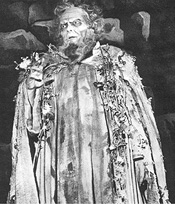 Welles
went to Hollywood and immortality with Citizen Kane in 1941, but he returned
to Shakespeare on both stage and screen many times. When he started gaining
a reputation as a maverick filmmaker who was incapable of working with the front
office or in bringing his movies in on budget, he made a film of Macbeth
for low-level Republic Pictures in an effort to prove that he was capable of
doing both. But the film was assigned the budget and logistics of a typical
Republic Western (with titles like a Desperadoes of Dodge City and The
Gay Ranchero) and was not only a critical and commercial disaster, but dissuaded
Laurence Olivier from filming the play himself (one of his greatest roles) and
instead prompted him to make his overaged and badly butchered film of Hamlet.
Welles fared better when he played Othello in London in 1951, and though his
film version suffered financial problems which required three years to shoot
and resulted in frustrating soundtrack inconsistencies and an atrocious performance
by Micheál MacLiammóir as Iago, it is pictorially splendid and
won Welles the Palm d'Orr at the 1952 Cannes Film Festival. Welles had more
problems with King Lear, starring in a sloppy television version for
CBS in 1953 (for director Peter Brook, who had much greater success with the
material a decade later) and returning to the play at the New York City Center
in 1956 in his own production (pictured), which was by many accounts a total
disaster and proved star-crossed when Welles broke his ankle prior to opening
and played Lear in a wheelchair.
Welles
went to Hollywood and immortality with Citizen Kane in 1941, but he returned
to Shakespeare on both stage and screen many times. When he started gaining
a reputation as a maverick filmmaker who was incapable of working with the front
office or in bringing his movies in on budget, he made a film of Macbeth
for low-level Republic Pictures in an effort to prove that he was capable of
doing both. But the film was assigned the budget and logistics of a typical
Republic Western (with titles like a Desperadoes of Dodge City and The
Gay Ranchero) and was not only a critical and commercial disaster, but dissuaded
Laurence Olivier from filming the play himself (one of his greatest roles) and
instead prompted him to make his overaged and badly butchered film of Hamlet.
Welles fared better when he played Othello in London in 1951, and though his
film version suffered financial problems which required three years to shoot
and resulted in frustrating soundtrack inconsistencies and an atrocious performance
by Micheál MacLiammóir as Iago, it is pictorially splendid and
won Welles the Palm d'Orr at the 1952 Cannes Film Festival. Welles had more
problems with King Lear, starring in a sloppy television version for
CBS in 1953 (for director Peter Brook, who had much greater success with the
material a decade later) and returning to the play at the New York City Center
in 1956 in his own production (pictured), which was by many accounts a total
disaster and proved star-crossed when Welles broke his ankle prior to opening
and played Lear in a wheelchair.
 Welles'
final Shakespearean performance was initially considered to be a failure but
has been vindicated by time. He played Falstaff in his own staging of several
of the Shakespeare history plays he titled Five Kings in 1939, and was
so pleased with the result that he made the journey to Hollywood to pitch a
film version, only to be sidetracked by Citizen Kane. He returned to
the role and concept in a new production, now titled Chimes at Midnight,
at the Grand Opera House, Belfast in what proved to be his final theatre appearance
in 1960. Making the film was his typical uphill battle, but he assembled a brilliant
cast that included John Gielgud in a definitive performance as Henry IV, Margaret
Rutherford as Mistress Quickly, and Keith Baxter as Prince Hal. But the critics
chose to concentrate on Welles' usual soundtrack problems and gave the film
largely negative reviews, resulting in a financial failure that derailed Welles'
plans to film The Tempest with himself as Caliban and Gielgud as Prospero.
But Chimes at Midnight was Welles' own favorite of his films, and its
reputation has risen with the years. Welles' performance as Falstaff is one
of the greatest since Ralph Richardson and his direction is imaginative and
compelling. Regrettably, Chimes at Midnight is not widely available on
DVD in the United States, although excellent Spanish and Japanese version are
available in a limited basis in English-speaking countries and may hopefully
someday revive interest in the film.
Welles'
final Shakespearean performance was initially considered to be a failure but
has been vindicated by time. He played Falstaff in his own staging of several
of the Shakespeare history plays he titled Five Kings in 1939, and was
so pleased with the result that he made the journey to Hollywood to pitch a
film version, only to be sidetracked by Citizen Kane. He returned to
the role and concept in a new production, now titled Chimes at Midnight,
at the Grand Opera House, Belfast in what proved to be his final theatre appearance
in 1960. Making the film was his typical uphill battle, but he assembled a brilliant
cast that included John Gielgud in a definitive performance as Henry IV, Margaret
Rutherford as Mistress Quickly, and Keith Baxter as Prince Hal. But the critics
chose to concentrate on Welles' usual soundtrack problems and gave the film
largely negative reviews, resulting in a financial failure that derailed Welles'
plans to film The Tempest with himself as Caliban and Gielgud as Prospero.
But Chimes at Midnight was Welles' own favorite of his films, and its
reputation has risen with the years. Welles' performance as Falstaff is one
of the greatest since Ralph Richardson and his direction is imaginative and
compelling. Regrettably, Chimes at Midnight is not widely available on
DVD in the United States, although excellent Spanish and Japanese version are
available in a limited basis in English-speaking countries and may hopefully
someday revive interest in the film.