
 When
Patrick Stewart first played Claudius in 1980, he was a relatively
unknown member of the Royal Shakespeare Company whose only previous experience
with the play was in his third appearance for the RSC in 1966, as a replacement
for the Player King in the closing performances of David Warner’s Hamlet
in London. Stewart’s star gradually rose in the years since, winning praise
for his Shylock and an Olivier Award for his Enobarbus in Peter Brook’s
1979 production of Antony and Cleopatra, as well as international acclaim
for his appearance as the Roman soldier Sejanus in the miniseries I, Claudius.
When
Patrick Stewart first played Claudius in 1980, he was a relatively
unknown member of the Royal Shakespeare Company whose only previous experience
with the play was in his third appearance for the RSC in 1966, as a replacement
for the Player King in the closing performances of David Warner’s Hamlet
in London. Stewart’s star gradually rose in the years since, winning praise
for his Shylock and an Olivier Award for his Enobarbus in Peter Brook’s
1979 production of Antony and Cleopatra, as well as international acclaim
for his appearance as the Roman soldier Sejanus in the miniseries I, Claudius.
 Stewart’s
position at the RSC was such that he was assigned the role of Claudius in the
BBC production of Hamlet that was part of the ambitious Complete
Dramatic Works of William Shakespeare. The Melancholy Dane was portrayed
by Stewart’s I, Claudius co-star Derek Jacobi, already regarded
as one of the greatest Hamlets of the century by virtue of his stage performance
with the Prospect Theatre Company; and Stewart matched the great Shakespearean
in a performance of staggering power and humanity that projected a strength
and maturity that belied the chronological difference in the age of the two
actors (Jacobi is actually two years older than Stewart). Jacobi is an unforgettable
Hamlet in the production - by far the finest episode of the series - but Stewart
makes no less of an impression in his understated performance – arguably
the most memorable depiction of the role in the play’s history.
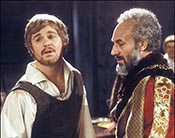
Stewart’s
position at the RSC was such that he was assigned the role of Claudius in the
BBC production of Hamlet that was part of the ambitious Complete
Dramatic Works of William Shakespeare. The Melancholy Dane was portrayed
by Stewart’s I, Claudius co-star Derek Jacobi, already regarded
as one of the greatest Hamlets of the century by virtue of his stage performance
with the Prospect Theatre Company; and Stewart matched the great Shakespearean
in a performance of staggering power and humanity that projected a strength
and maturity that belied the chronological difference in the age of the two
actors (Jacobi is actually two years older than Stewart). Jacobi is an unforgettable
Hamlet in the production - by far the finest episode of the series - but Stewart
makes no less of an impression in his understated performance – arguably
the most memorable depiction of the role in the play’s history.
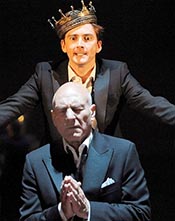
 When
Stewart returned to the part in 2008, he was one of the most famous actors in
the history of the RSC by virtue of his appearances in Star Trek: The Next
Generation and the X-Men film franchise. He had continued to make
memorable (and occasionally historic) performances in Shakespeare, as Marc Antony,
Prospero, Othello, and an Evening Standard Award-winning Macbeth, when he opted
to revive his Claudius at the RSC’s Courtyard Theatre. The production
was a sell-out after it was announced that Stewart’s Hamlet would be science
fiction cohort David Tennant, star of the long-running BBC institution Dr.
Who. While Tennant failed to rise to the immortal peaks that Jacobi lofted
to as Hamlet (due, in part, to his suffering a back injury that limited his
appearances during the London run), he was generally acclaimed in the role.
It was Stewart, however, who nabbed his third Olivier Award for the production
(after his Enobarbus and his acclaimed one-man performance in A Christmas
Carol), in which he also played Hamlet’s father’s ghost. Charles
Spencer wrote in The Telegraph, “I have no reservations at all about Stewart,
who delivers the strongest, scariest performance as Claudius I have seen. A
modern tyrant in a surveillance state full of spies, informers and two-way mirrors
in Doran's thriller-like production, he presents a façade of smiling,
bespectacled geniality.”
When
Stewart returned to the part in 2008, he was one of the most famous actors in
the history of the RSC by virtue of his appearances in Star Trek: The Next
Generation and the X-Men film franchise. He had continued to make
memorable (and occasionally historic) performances in Shakespeare, as Marc Antony,
Prospero, Othello, and an Evening Standard Award-winning Macbeth, when he opted
to revive his Claudius at the RSC’s Courtyard Theatre. The production
was a sell-out after it was announced that Stewart’s Hamlet would be science
fiction cohort David Tennant, star of the long-running BBC institution Dr.
Who. While Tennant failed to rise to the immortal peaks that Jacobi lofted
to as Hamlet (due, in part, to his suffering a back injury that limited his
appearances during the London run), he was generally acclaimed in the role.
It was Stewart, however, who nabbed his third Olivier Award for the production
(after his Enobarbus and his acclaimed one-man performance in A Christmas
Carol), in which he also played Hamlet’s father’s ghost. Charles
Spencer wrote in The Telegraph, “I have no reservations at all about Stewart,
who delivers the strongest, scariest performance as Claudius I have seen. A
modern tyrant in a surveillance state full of spies, informers and two-way mirrors
in Doran's thriller-like production, he presents a façade of smiling,
bespectacled geniality.”