
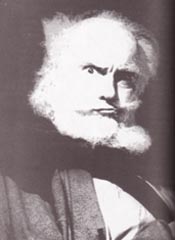
 Ralph
Richardson (1902-1983) is frequently named, along with Laurence Olivier
and John Gielgud, as being among the triumvirate of great Shakespearean actors
of the twentieth century. A close examination of Richardson's credits indicates
that this is something of an exaggeration, for while he gave triumphant performances
as Bottom, Toby Belch, Enobarbus, Caliban, and Shylock, he often floundered
in Shakespearean roles such as Prospero, Timon of Athens, Othello, and a particularly
disastrous Macbeth. And he never achieved the remarkable Shakespearean heights
that Gielgud (Hamlet, Richard II, Prospero, Lear, Benedick) or Olivier (Richard
III, Macbeth, Othello, Coriolanus, Titus Andronicus) reached on a regular basis,
or for that matter Peggy Ashcroft or Ian McKellen, whose careers were more consistently
devoted to Shakespeare than Richardson's.
Ralph
Richardson (1902-1983) is frequently named, along with Laurence Olivier
and John Gielgud, as being among the triumvirate of great Shakespearean actors
of the twentieth century. A close examination of Richardson's credits indicates
that this is something of an exaggeration, for while he gave triumphant performances
as Bottom, Toby Belch, Enobarbus, Caliban, and Shylock, he often floundered
in Shakespearean roles such as Prospero, Timon of Athens, Othello, and a particularly
disastrous Macbeth. And he never achieved the remarkable Shakespearean heights
that Gielgud (Hamlet, Richard II, Prospero, Lear, Benedick) or Olivier (Richard
III, Macbeth, Othello, Coriolanus, Titus Andronicus) reached on a regular basis,
or for that matter Peggy Ashcroft or Ian McKellen, whose careers were more consistently
devoted to Shakespeare than Richardson's.
But Richardson was among the greatest actors of his generation, achieving classical heights in non-Shakespearean roles like Cyrano de Bergerac, Peer Gynt, John Gabriel Borkman, Bluntschli in Arms and the Man, Sir Peter Teazle in School for Scandal, and Face in The Alchemist and consistent success in contemporary plays (far greater than Gielgud or Olivier) like The Amazing Dr. Clitterhouse, Johnson Over Jordan, The Heiress, Flowering Cherry, The Waltz of the Toreadors, Home, Lloyd George Knew My Father, and No Man's Land.
 But
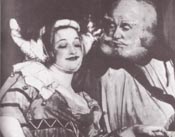
Richardson's greatest success was in a Shakespearean role. In 1944 he
joined with Olivier and John Burrell to act as co-directors of the newly formed
Old Vic company, where he and Olivier competed with each other for giving the
most immortal performance of the post-war era (Richardson's Peer Gynt to Olivier's
Richard III, Richardson's Cyrano to Olivier's King Lear). Richardson's answer
to Olivier's famous double act as Oedipus and Mr. Puff in The Critic
was to give his own double act as Sir John Falstaff in Henry IV, Parts I
and II. Given outstanding support by Olivier as Hotspur and Justice Shallow,
Richardson's Falstaff was immediately regarded as the definitive interpretation
of the role, obliterating the memory of Samuel Phelps and Herbert Beerbohm Tree
and providing an Everest for later Falstaffs like Anthony Quayle, Orson Welles
and Kevin Kline to falter at before reaching the summit. James Agate wrote of
Richardson's work in Part I "He had everything the part wants -
the exuberance, the mischief, the gusto…" and in Part II "Wisely,
Mr. Richardson is content in this second part not to do but to be … Here
is something better than virtuosity in character acting - the spirit of the
part shining through the actor." After opening at the Vic in the role in
1945, Richardson toured with the Old Vic company in the two productions (in
repertoire with Oedipus and The Critic) in North America throughout
1946, then giving up the role forever (despite numerous appeals to return to
it) to lesser mortals who were never able to live up to his sublime artistry.
But
Richardson's greatest success was in a Shakespearean role. In 1944 he
joined with Olivier and John Burrell to act as co-directors of the newly formed
Old Vic company, where he and Olivier competed with each other for giving the
most immortal performance of the post-war era (Richardson's Peer Gynt to Olivier's
Richard III, Richardson's Cyrano to Olivier's King Lear). Richardson's answer
to Olivier's famous double act as Oedipus and Mr. Puff in The Critic
was to give his own double act as Sir John Falstaff in Henry IV, Parts I
and II. Given outstanding support by Olivier as Hotspur and Justice Shallow,
Richardson's Falstaff was immediately regarded as the definitive interpretation
of the role, obliterating the memory of Samuel Phelps and Herbert Beerbohm Tree
and providing an Everest for later Falstaffs like Anthony Quayle, Orson Welles
and Kevin Kline to falter at before reaching the summit. James Agate wrote of
Richardson's work in Part I "He had everything the part wants -
the exuberance, the mischief, the gusto…" and in Part II "Wisely,
Mr. Richardson is content in this second part not to do but to be … Here
is something better than virtuosity in character acting - the spirit of the
part shining through the actor." After opening at the Vic in the role in
1945, Richardson toured with the Old Vic company in the two productions (in
repertoire with Oedipus and The Critic) in North America throughout
1946, then giving up the role forever (despite numerous appeals to return to
it) to lesser mortals who were never able to live up to his sublime artistry.