
 Peter
O'Toole (1932-2013) was one of the most promising actors on the English stage in 1960,
having achieved notoriety through his appearances at the Bristol Old Vic in
plays like Man and Superman, Waiting for Godot, and an especially noteworthy
performance as Hamlet, when he was invited by Peter Hall to appear at the Stratford
Memorial Theatre in The Merchant of Venice, Troilus and Cressida,
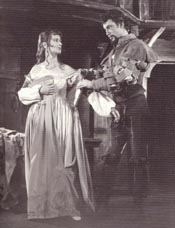
and The Taming of the Shrew. O'Toole's first great triumph in that memorable
season was Shylock, which he played nontraditionally as a more youthful courtier
and won raves from the critics for his brilliance and originality. But his greatest
success was in a role he seemed born to play, the rollicking, larger-than-life
Petruchio in The Taming of the Shrew. Teamed with Peggy Ashcroft as Katarina,
O'Toole was a sensation in the role and Hall's production of the play was acclaimed
as definitive. "In Peter O'Toole," wrote Martin Shulman in The Evening
Standard, "we have the most aggressive, virile, dominating Petruchio in
years. Any woman who stood in his way would be instantly blown apart by a puff
or a sneeze. It is a marvelously comic performance which will put heart unto
even the most browbeaten husband in the audience."
Peter
O'Toole (1932-2013) was one of the most promising actors on the English stage in 1960,
having achieved notoriety through his appearances at the Bristol Old Vic in
plays like Man and Superman, Waiting for Godot, and an especially noteworthy
performance as Hamlet, when he was invited by Peter Hall to appear at the Stratford
Memorial Theatre in The Merchant of Venice, Troilus and Cressida,
and The Taming of the Shrew. O'Toole's first great triumph in that memorable
season was Shylock, which he played nontraditionally as a more youthful courtier
and won raves from the critics for his brilliance and originality. But his greatest
success was in a role he seemed born to play, the rollicking, larger-than-life
Petruchio in The Taming of the Shrew. Teamed with Peggy Ashcroft as Katarina,
O'Toole was a sensation in the role and Hall's production of the play was acclaimed
as definitive. "In Peter O'Toole," wrote Martin Shulman in The Evening
Standard, "we have the most aggressive, virile, dominating Petruchio in
years. Any woman who stood in his way would be instantly blown apart by a puff
or a sneeze. It is a marvelously comic performance which will put heart unto
even the most browbeaten husband in the audience."
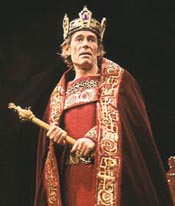 O'Toole
seemed poised to take his place as the preeminent classical actor in Britain,
and signed a contract with Stratford (now renamed the Royal Shakespeare Company)
to play Henry II in Jean Anouilh's play Becket. But an offer from David
Lean to play T. E. Lawrence changed the course of O'Toole's career (and created
a rift with the RSC, when he pulled out of Becket, which never fully
healed). O'Toole continued to appear on stage, having notable successes in Ride
a Cock Horse, Uncle Vanya, and reprises of his early successes in Waiting
for Godot and Man and Superman, but his attempts at Shakespeare were
not well received. He made a return to Hamlet under prestigious circumstances
as the premiere production of the Royal National Theatre but his performance
was a shadow of his success at the Bristol Old Vic, largely because of O'Toole's
lack of chemistry with the production's director Laurence Olivier (who was seldom
at his peak in that capacity). But the disappointment of O'Toole's Hamlet was
nothing compared to the fiasco of his next Shakespearean appearance as Macbeth
at the Old Vic in 1980. Given free reign by the theatre to produce the play
as he wished, O'Toole engaged film director Bryan Forbes (who has almost no
theatre experience) to stage the production and put O'Toole's own frequently
disorganized and mutually contradictory concepts about Macbeth into play.
O'Toole was mindful enough about the play's reputation for bad luck to never
call it by name (referring to it as Harry Lauder, after the legendary
Music Hall performer), but the resulting catastrophe outdid anything that had
been previously inflicted on it (although the production's infamy ultimately
caused it to be a sellout). Michael Billington wrote in The Guardian
that O'Toole spoke with "a monotonous tenor bark as if addressing an audience
of Eskimos" and Jack Tinker opined in The Daily Mail "It is
surely the most hilarious miscalculation to totter out of Duncan's death chamber
covered from head to toe in bright red gore, clutching two dripping swords,
and eventually gasp out the purely superfluous information: 'I have done the
deed.'"
O'Toole
seemed poised to take his place as the preeminent classical actor in Britain,
and signed a contract with Stratford (now renamed the Royal Shakespeare Company)
to play Henry II in Jean Anouilh's play Becket. But an offer from David
Lean to play T. E. Lawrence changed the course of O'Toole's career (and created
a rift with the RSC, when he pulled out of Becket, which never fully
healed). O'Toole continued to appear on stage, having notable successes in Ride
a Cock Horse, Uncle Vanya, and reprises of his early successes in Waiting
for Godot and Man and Superman, but his attempts at Shakespeare were
not well received. He made a return to Hamlet under prestigious circumstances
as the premiere production of the Royal National Theatre but his performance
was a shadow of his success at the Bristol Old Vic, largely because of O'Toole's
lack of chemistry with the production's director Laurence Olivier (who was seldom
at his peak in that capacity). But the disappointment of O'Toole's Hamlet was
nothing compared to the fiasco of his next Shakespearean appearance as Macbeth
at the Old Vic in 1980. Given free reign by the theatre to produce the play
as he wished, O'Toole engaged film director Bryan Forbes (who has almost no
theatre experience) to stage the production and put O'Toole's own frequently
disorganized and mutually contradictory concepts about Macbeth into play.
O'Toole was mindful enough about the play's reputation for bad luck to never
call it by name (referring to it as Harry Lauder, after the legendary
Music Hall performer), but the resulting catastrophe outdid anything that had
been previously inflicted on it (although the production's infamy ultimately
caused it to be a sellout). Michael Billington wrote in The Guardian
that O'Toole spoke with "a monotonous tenor bark as if addressing an audience
of Eskimos" and Jack Tinker opined in The Daily Mail "It is
surely the most hilarious miscalculation to totter out of Duncan's death chamber
covered from head to toe in bright red gore, clutching two dripping swords,
and eventually gasp out the purely superfluous information: 'I have done the
deed.'"
 Fortunately,
O'Toole was able to redeem his theatrical reputation with powerful performances
in Shavian roles that he had appeared in successfully earlier in his career,
as John Tanner in Man and Superman, King Magnus in The Apple Cart,
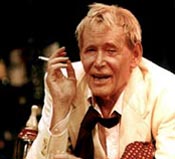
and Henry Higgins in his belated Broadway debut in Pygmalion. But when
O'Toole finally braved a theatre role that he had not played already, as the
drunken Soho journalist in Jeffrey Bernard is Unwell (pictured), he had
one of the greatest successes of his career and won the Laurence Olivier Award
for his virtuoso performance. But he never again returned to Shakespeare.
Fortunately,
O'Toole was able to redeem his theatrical reputation with powerful performances
in Shavian roles that he had appeared in successfully earlier in his career,
as John Tanner in Man and Superman, King Magnus in The Apple Cart,
and Henry Higgins in his belated Broadway debut in Pygmalion. But when
O'Toole finally braved a theatre role that he had not played already, as the
drunken Soho journalist in Jeffrey Bernard is Unwell (pictured), he had
one of the greatest successes of his career and won the Laurence Olivier Award
for his virtuoso performance. But he never again returned to Shakespeare.