
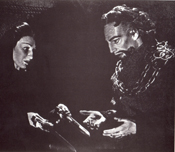
 Laurence
Olivier (1907-1989) made his first attempt as Macbeth during the checkered
1937-38 season at the Old Vic, in which he scored personal triumphs as Sir Toby
Belch, Henry V, and Coriolanus, and critical disdain for his performances as
Hamlet and Iago. His Macbeth was the most critically divided performance of
the season; praised for his mental grasp of the character but derided for not
being on a par with Judith Anderson's Lady Macbeth and for his overly-elaborate,
stylized makeup (Vivian Leigh reported "You hear Macbeth's first line,
then Larry's makeup comes on, then Banquo comes on, then Larry comes on").
James Agate's review analyzed the plusses and minuses of Olivier's performance
and determined in the end that he came up short, but ended on a note of hopefulness.
"To sum it up, this may not be the whole of Macbeth. Ideally considered,
the performance lacks grandeur, and the actor should look to his gait, which
smacks too much of the modern prize-ring. But the mental grasp is here, and
so too is enough of the character to take one spectator out of the Waterloo
Road and set him down on that dubious heath. Further, is it not a point that
whereas a stripling can fly at Hamlet, Macbeth is a weighty business which requires
the momentum of age. Mr. Olivier will probably play the part twice as well when
he has twice his present years."
Laurence
Olivier (1907-1989) made his first attempt as Macbeth during the checkered
1937-38 season at the Old Vic, in which he scored personal triumphs as Sir Toby
Belch, Henry V, and Coriolanus, and critical disdain for his performances as
Hamlet and Iago. His Macbeth was the most critically divided performance of
the season; praised for his mental grasp of the character but derided for not
being on a par with Judith Anderson's Lady Macbeth and for his overly-elaborate,
stylized makeup (Vivian Leigh reported "You hear Macbeth's first line,
then Larry's makeup comes on, then Banquo comes on, then Larry comes on").
James Agate's review analyzed the plusses and minuses of Olivier's performance
and determined in the end that he came up short, but ended on a note of hopefulness.
"To sum it up, this may not be the whole of Macbeth. Ideally considered,
the performance lacks grandeur, and the actor should look to his gait, which
smacks too much of the modern prize-ring. But the mental grasp is here, and
so too is enough of the character to take one spectator out of the Waterloo
Road and set him down on that dubious heath. Further, is it not a point that
whereas a stripling can fly at Hamlet, Macbeth is a weighty business which requires
the momentum of age. Mr. Olivier will probably play the part twice as well when
he has twice his present years."
Olivier made several attempts at returning to the role in the ensuing years, approaching impresario Binkie Beaumont about producing him in a season of the four major Shakespearean tragedies in 1940 (the proposal falling apart when Beaumont would agree only if Olivier's arch-rival John Gielgud alternated in the lead roles), and attempting to film the play following the success of Henry V, but deciding against it after learning that Orson Welles was doing his own film of Macbeth that would reach theatres first, and opting instead to make his Academy Award-winning version of Hamlet.
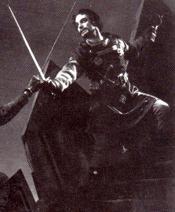 Olivier's
career was at a crossroads when he finally did return to Macbeth in 1955. His
career-making performances as Richard III, Oedipus, Mr. Puff, Hotspur, and Justice
Shallow were a decade behind him, and his recent performances in fluff like
Venus Observed and The Sleeping Prince had led to accusations
that he was coasting. He was therefore in a somewhat uncomfortable position
when he arrived at Stratford-Upon-Avon for his first appearances at the Memorial
Theatre, made even worse by the disappointing reception of his controversial
Malvolio in a lackluster production of Twelfth Night directed by John
Gielgud. His black-hearted Macbeth, however, not only reestablished his reputation,
his performance was regarded as the greatest interpretation of the role in living
memory. Though Glenn Byam Shaw's production was criticized for not being on
a par with Olivier's performance and Vivian Leigh's Lady Macbeth came in for
particular criticism (although Olivier graciously defended her in his autobiography,
calling her performance the greatest he had ever seen in the role), Olivier's
Macbeth was universally hailed as a masterpiece. Kenneth Tynan wrote "Last
Tuesday Sir Laurence shook hands with greatness, and within a week or so the
performance will have ripened into a masterpiece; not of the superficial, booming,
have-a -bash kind, but the real thing, a structure of perfect forethought and
proportion lit by flashes of intuitive lightning."
Olivier's
career was at a crossroads when he finally did return to Macbeth in 1955. His
career-making performances as Richard III, Oedipus, Mr. Puff, Hotspur, and Justice
Shallow were a decade behind him, and his recent performances in fluff like
Venus Observed and The Sleeping Prince had led to accusations
that he was coasting. He was therefore in a somewhat uncomfortable position
when he arrived at Stratford-Upon-Avon for his first appearances at the Memorial
Theatre, made even worse by the disappointing reception of his controversial
Malvolio in a lackluster production of Twelfth Night directed by John
Gielgud. His black-hearted Macbeth, however, not only reestablished his reputation,
his performance was regarded as the greatest interpretation of the role in living
memory. Though Glenn Byam Shaw's production was criticized for not being on
a par with Olivier's performance and Vivian Leigh's Lady Macbeth came in for
particular criticism (although Olivier graciously defended her in his autobiography,
calling her performance the greatest he had ever seen in the role), Olivier's
Macbeth was universally hailed as a masterpiece. Kenneth Tynan wrote "Last
Tuesday Sir Laurence shook hands with greatness, and within a week or so the
performance will have ripened into a masterpiece; not of the superficial, booming,
have-a -bash kind, but the real thing, a structure of perfect forethought and
proportion lit by flashes of intuitive lightning."
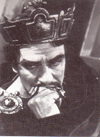 After
his triumph as Macbeth, Olivier's hopes to immortalize his performance on film
intensified. It appeared as though he would achieve his dream through the financial
backing of producer Michael Todd (who had just won the Best Picture Oscar for
his film Around the World in 80 Days), but after Todd's death in a plane
crash and the financial failure of his film of Richard III, Olivier was
unable to raise the money for his dream project. He considered it the greatest
disappointment of his career.
After
his triumph as Macbeth, Olivier's hopes to immortalize his performance on film
intensified. It appeared as though he would achieve his dream through the financial
backing of producer Michael Todd (who had just won the Best Picture Oscar for
his film Around the World in 80 Days), but after Todd's death in a plane
crash and the financial failure of his film of Richard III, Olivier was
unable to raise the money for his dream project. He considered it the greatest
disappointment of his career.