
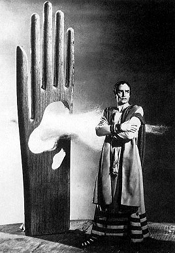
 Laurence
Olivier (1907-1989) did not emerge as the theatrical talent we now regard
as the greatest of the 20th century until the 1940s, and his first test as a
classical actor (following his London success as Romeo) as the leading man for
the Old Vic's 1937/38 season was a checkered affair. He scored a triumph as
Toby Belch in his only attempt at the role, but his towering performances of
the tragic roles he took on that season - Hamlet, Henry V, Macbeth - weren't
enacted until his gifts matured (he also played an unsuccessful Iago that season,
setting the stage for his legendary Othello in the 1960s). He did score one
magnificent personal success in his final tragic role of the season, Coriolanus.
While critics were dubious of the outlandish makeup he favored at the time and
his reliance on sometimes vulgar stage business, they had only praise for his
humor, magnificent speech (James Agate, who had mauled his speaking of poetry
in the past, wrote"Vocally, Mr. Olivier's performance is magnificent; his
voice is gaining depth and resonance, and his range of tone is now extraordinary")
and his physical daring, especially for his spectacular death-fall down a long
flight of stairs that has passed into legend. It is Coriolanus, more than any
other role, that began the celebrated succession of dazzling masterworks that
saw Olivier's career pass into the status of myth.
Laurence
Olivier (1907-1989) did not emerge as the theatrical talent we now regard
as the greatest of the 20th century until the 1940s, and his first test as a
classical actor (following his London success as Romeo) as the leading man for
the Old Vic's 1937/38 season was a checkered affair. He scored a triumph as
Toby Belch in his only attempt at the role, but his towering performances of
the tragic roles he took on that season - Hamlet, Henry V, Macbeth - weren't
enacted until his gifts matured (he also played an unsuccessful Iago that season,
setting the stage for his legendary Othello in the 1960s). He did score one
magnificent personal success in his final tragic role of the season, Coriolanus.
While critics were dubious of the outlandish makeup he favored at the time and
his reliance on sometimes vulgar stage business, they had only praise for his
humor, magnificent speech (James Agate, who had mauled his speaking of poetry
in the past, wrote"Vocally, Mr. Olivier's performance is magnificent; his
voice is gaining depth and resonance, and his range of tone is now extraordinary")
and his physical daring, especially for his spectacular death-fall down a long
flight of stairs that has passed into legend. It is Coriolanus, more than any
other role, that began the celebrated succession of dazzling masterworks that
saw Olivier's career pass into the status of myth.
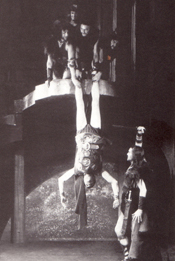 It
was a performance that might have gone done in history as the greatest ever
in the role if he had not returned to Stratford in 1959 (where had recently
given definitive performances as Macbeth and Titus Andronicus) at the height
of his powers to obliterate its memory in a production directed by Peter Hall
that continues to be ranked as the greatest in the play's history. Thumbing
his nose at his previous triumphant death fall at the age of 30, Olivier (now
52) stunned audiences by falling over a high platform backwards and being caught
at the ankles by two soldiers who left him hanging upside-down. "It is
a performance which keeps the audience in thrall," wrote Phyllis Hope-Wallace
in the Manchester Guardian, "lit with surprise and danger, unpredictable
and alluring, and the death is overwhelmingly tragic."
It
was a performance that might have gone done in history as the greatest ever
in the role if he had not returned to Stratford in 1959 (where had recently
given definitive performances as Macbeth and Titus Andronicus) at the height
of his powers to obliterate its memory in a production directed by Peter Hall
that continues to be ranked as the greatest in the play's history. Thumbing
his nose at his previous triumphant death fall at the age of 30, Olivier (now
52) stunned audiences by falling over a high platform backwards and being caught
at the ankles by two soldiers who left him hanging upside-down. "It is
a performance which keeps the audience in thrall," wrote Phyllis Hope-Wallace
in the Manchester Guardian, "lit with surprise and danger, unpredictable
and alluring, and the death is overwhelmingly tragic."