
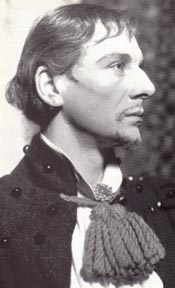
 The
history of the legendary 1935 production of Romeo and Juliet featuring
John Gielgud (1904-2000) and Laurence Olivier alternating in the roles
of Romeo and Mercutio becomes all the more enticing when considering how its
celebrated chips fell into place by the slightest of chances. Gielgud was set
to direct a production of A Tale of Two Cities by an up-and-coming playwright
named Terrence Rattigan at the New Theatre when he got a letter from the elderly
Victorian actor Charles Martin Harvey angrily stating his intent to come out
with yet another "farewell tour" of The Only Way, his own adaptation
of the Dickens novel that had been his signature role for decades, and he considered
Gielgud' s production unfair competition. Against his better judgment (and to
Rattigan's great disappointment) Gielgud decided to shelve A Tale of Two
Cities, concluding that the sets that had been designed for that production
would serve for Romeo and Juliet. Having already played Romeo twice and
feeling that directing and taking on the lead role might be spreading himself
too thin, he decided to play Mercutio and cast one of most promising rising
stars of the British stage as Romeo - Robert Donat.
The
history of the legendary 1935 production of Romeo and Juliet featuring
John Gielgud (1904-2000) and Laurence Olivier alternating in the roles
of Romeo and Mercutio becomes all the more enticing when considering how its
celebrated chips fell into place by the slightest of chances. Gielgud was set
to direct a production of A Tale of Two Cities by an up-and-coming playwright
named Terrence Rattigan at the New Theatre when he got a letter from the elderly
Victorian actor Charles Martin Harvey angrily stating his intent to come out
with yet another "farewell tour" of The Only Way, his own adaptation
of the Dickens novel that had been his signature role for decades, and he considered
Gielgud' s production unfair competition. Against his better judgment (and to
Rattigan's great disappointment) Gielgud decided to shelve A Tale of Two
Cities, concluding that the sets that had been designed for that production
would serve for Romeo and Juliet. Having already played Romeo twice and
feeling that directing and taking on the lead role might be spreading himself
too thin, he decided to play Mercutio and cast one of most promising rising
stars of the British stage as Romeo - Robert Donat.
As chance would have it, Donat was in the midst of undertaking his own production of R&J, and after meeting with Gielgud he graciously agreed to drop his plans. He declined to play Romeo for Gielgud however, and suggested instead a popular young matinee idol named Laurence Olivier, who had appeared under Gielgud's direction at short notice in the play Queen of Scots and who was planning his own production with his wife Jill Esmond as Juliet. Gielgud was unconvinced, as Olivier had no experience in a major Shakespearean role at the time, so he allowed him to take the part only if they alternated as Romeo and Mercutio in case Olivier's notices were mixed as Romeo and hurt the box office (details of the production and of Olivier and Gielgud's wary lifelong relationship are brilliantly examined in Jonathan Croall's superb biography Gielgud: A Theatrical Life 1904-2000).
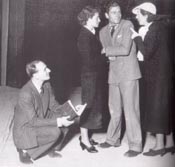 In
fact, Olivier's notices were mixed, with most critics admiring his passion
but deploring his speaking of the verse (which Gielgud had bullied him about
a great deal in rehearsals). No doubt with hindsight Olivier later claimed that
he was "trying to sell realism in Shakespeare," but the reality is
that he was probably held back by his own inexperience at the time (his 1940
appearance as Romeo on Broadway under his own direction was a fiasco). The experience
served him well however, as the phenomenal success of the production launched
his career as a Shakespearean actor and won him an invitation to be the leading
man of the Old Vic in 1937 (in which he enjoyed the first of his many triumphant
successes that would ultimately crown him as the greatest classical actor of
the twentieth century) as well as the role of Orlando in Elizabeth Bergner's
film of As You Like It.
In
fact, Olivier's notices were mixed, with most critics admiring his passion
but deploring his speaking of the verse (which Gielgud had bullied him about
a great deal in rehearsals). No doubt with hindsight Olivier later claimed that
he was "trying to sell realism in Shakespeare," but the reality is
that he was probably held back by his own inexperience at the time (his 1940
appearance as Romeo on Broadway under his own direction was a fiasco). The experience
served him well however, as the phenomenal success of the production launched
his career as a Shakespearean actor and won him an invitation to be the leading
man of the Old Vic in 1937 (in which he enjoyed the first of his many triumphant
successes that would ultimately crown him as the greatest classical actor of
the twentieth century) as well as the role of Orlando in Elizabeth Bergner's
film of As You Like It.
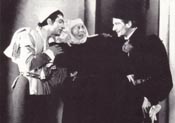 Modern
opinion of the production is that performances with Olivier's passionate but
rough Romeo and Gielgud's lyrical Mercutio were considered considered superior
to when the actors swapped roles (Peggy Ashcroft later said that she considered
them the definitive performances of those characters), but an analysis of the
reviews indicates that Olivier was greatly preferred as Mercutio to Romeo, with
Gielgud was largely thought to be better than Olivier in both roles. Of his
two performances, he was certainly more praised as Mercutio (particularly for
his reading of the Queen Mab speech) and his performance of the role in that
legendary production has had more praise heaped upon it than any other actor's
attempt at it.
Modern
opinion of the production is that performances with Olivier's passionate but
rough Romeo and Gielgud's lyrical Mercutio were considered considered superior
to when the actors swapped roles (Peggy Ashcroft later said that she considered
them the definitive performances of those characters), but an analysis of the
reviews indicates that Olivier was greatly preferred as Mercutio to Romeo, with
Gielgud was largely thought to be better than Olivier in both roles. Of his
two performances, he was certainly more praised as Mercutio (particularly for
his reading of the Queen Mab speech) and his performance of the role in that
legendary production has had more praise heaped upon it than any other actor's
attempt at it.
 It
is one of the great disappointments of twentieth century theatre that Gielgud
and Olivier never acted together on stage again. Olivier was said to have greatly
resented Gielgud's direction of him and maintained an aloofness towards him
for the rest of his life. Yet their paths nearly crossed numerous times again.
In 1940, Olivier approached the great London impresario Binkie Beaumont about
producing him in a season of the four great Shakespearean tragedies Hamlet,
Othello, King Lear, and Macbeth. Beaumont said he was only interested
if Olivier and Gielgud alternated as Hamlet/Laertes, Othello/Iago, Lear/Gloucester,
and Macbeth/Macduff; a proposal Olivier bluntly turned down. There are later
letters between Olivier and Gielgud discussing productions they might appear
in together, but they were either in plays that were fresh for Olivier but that
Gielgud had already made numerous historic appearances in (The School for
Scandal, Love for Love), Olivier was ultimately too ill to appear
in (The Pretenders, Tartuffe), or fanciful suggestions that came to nothing
(Julius Caesar). Gielgud did direct a 1955 production of Twelfth Night
at Stratford with Olivier as Malvolio (which was considered a great disappointment
in part because Olivier arrived at rehearsals with highly mannered - and controversial
- preconceptions of the role and refused to take direction, and Gielgud's typical
indecisiveness as a director threw the production into chaos) and they appeared
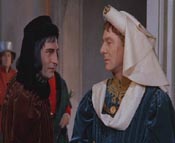
onscreen in Olivier's film of Richard III (pictured) and in Wagner
(references that say that Gielgud provided the voice of the Ghost in Olivier's
film of Hamlet are incorrect, as Olivier performed the voice himself).
Perhaps their most intriguing potential pairing was in Olivier's celebrated
film of Henry V, in which Gielgud lobbied to be cast as the Chorus, but
Olivier declined the offer, preferring Leslie Banks. He did offer Gielgud the
tiny role of the King of France. This time, it was Gielgud's turn to decline.
It
is one of the great disappointments of twentieth century theatre that Gielgud
and Olivier never acted together on stage again. Olivier was said to have greatly
resented Gielgud's direction of him and maintained an aloofness towards him
for the rest of his life. Yet their paths nearly crossed numerous times again.
In 1940, Olivier approached the great London impresario Binkie Beaumont about
producing him in a season of the four great Shakespearean tragedies Hamlet,
Othello, King Lear, and Macbeth. Beaumont said he was only interested
if Olivier and Gielgud alternated as Hamlet/Laertes, Othello/Iago, Lear/Gloucester,
and Macbeth/Macduff; a proposal Olivier bluntly turned down. There are later
letters between Olivier and Gielgud discussing productions they might appear
in together, but they were either in plays that were fresh for Olivier but that
Gielgud had already made numerous historic appearances in (The School for
Scandal, Love for Love), Olivier was ultimately too ill to appear
in (The Pretenders, Tartuffe), or fanciful suggestions that came to nothing
(Julius Caesar). Gielgud did direct a 1955 production of Twelfth Night
at Stratford with Olivier as Malvolio (which was considered a great disappointment
in part because Olivier arrived at rehearsals with highly mannered - and controversial
- preconceptions of the role and refused to take direction, and Gielgud's typical
indecisiveness as a director threw the production into chaos) and they appeared
onscreen in Olivier's film of Richard III (pictured) and in Wagner
(references that say that Gielgud provided the voice of the Ghost in Olivier's
film of Hamlet are incorrect, as Olivier performed the voice himself).
Perhaps their most intriguing potential pairing was in Olivier's celebrated
film of Henry V, in which Gielgud lobbied to be cast as the Chorus, but
Olivier declined the offer, preferring Leslie Banks. He did offer Gielgud the
tiny role of the King of France. This time, it was Gielgud's turn to decline.