
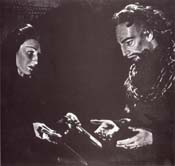
 Judith
Anderson (1898-1992) is more closely associated with the role of of Lady
Macbeth than any actress since Sarah Siddons. Anderson played her first Shakespearean
role in 1936, playing Gertrude to John Gielgud's Hamlet on Broadway, and was
invited to play Lady Macbeth in London at the Old Vic in 1937 opposite Laurence
Olivier. The superstition of the "Macbeth Curse" seemed to be fully
grounded in reality on that production, as the opening night was postponed from
a Tuesday to a Friday because it physically wasn't ready to open and Old Vic
director Lilian Baylis died on the Thursday. To add to the predicament, Olivier
(who would go on to give what is arguably the greatest performance of Macbeth
in history when he played it at Stratford-upon-Avon in 1955) aroused controversy
by applying an outrageous, Kabuki-like makeup that set him apart from the other
actors in the play. While Anderson was considered to be superior to Olivier,
she received mixed reviews and was generally thought to be largely ineffectual
in the role.
Judith
Anderson (1898-1992) is more closely associated with the role of of Lady
Macbeth than any actress since Sarah Siddons. Anderson played her first Shakespearean
role in 1936, playing Gertrude to John Gielgud's Hamlet on Broadway, and was
invited to play Lady Macbeth in London at the Old Vic in 1937 opposite Laurence
Olivier. The superstition of the "Macbeth Curse" seemed to be fully
grounded in reality on that production, as the opening night was postponed from
a Tuesday to a Friday because it physically wasn't ready to open and Old Vic
director Lilian Baylis died on the Thursday. To add to the predicament, Olivier
(who would go on to give what is arguably the greatest performance of Macbeth
in history when he played it at Stratford-upon-Avon in 1955) aroused controversy
by applying an outrageous, Kabuki-like makeup that set him apart from the other
actors in the play. While Anderson was considered to be superior to Olivier,
she received mixed reviews and was generally thought to be largely ineffectual
in the role.
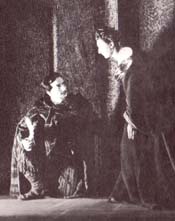 The
critical consensus was decidedly different after Anderson returned to Lady Macbeth
in 1941, when she played it on Broadway opposite Maurice Evans under the direction
of Margaret Webster. Evans and Webster had developed a successful partnership
doing Shakespeare on the Great White Way, putting on record-setting productions
of Richard II, Hamlet, Henry IV, Part I, and Twelfth Night. Macbeth
continued the streak, as the staging ran for 131 performances - still the record
for the longest run of the play in Broadway history - and Anderson's was hailed
as the definitive depiction of the role in the 20th century. Brooks Atkinson
wrote in the New York Times "Miss Anderson's Lady Macbeth is her
most distinguished work in our theatre. It has a sculptured beauty in the early
scenes, and a resolution that seems to be fiercer than the body that contains
it. It is strong without being inhuman. And she has translated the sleep-walking
scene into something memorable; the nervous washing of the hands is almost too
frightful to be watched. Strange images of death haunt the magnificent acting
of Mr. Evans and Miss Anderson in these macabre scenes."
The
critical consensus was decidedly different after Anderson returned to Lady Macbeth
in 1941, when she played it on Broadway opposite Maurice Evans under the direction
of Margaret Webster. Evans and Webster had developed a successful partnership
doing Shakespeare on the Great White Way, putting on record-setting productions
of Richard II, Hamlet, Henry IV, Part I, and Twelfth Night. Macbeth
continued the streak, as the staging ran for 131 performances - still the record
for the longest run of the play in Broadway history - and Anderson's was hailed
as the definitive depiction of the role in the 20th century. Brooks Atkinson
wrote in the New York Times "Miss Anderson's Lady Macbeth is her
most distinguished work in our theatre. It has a sculptured beauty in the early
scenes, and a resolution that seems to be fiercer than the body that contains
it. It is strong without being inhuman. And she has translated the sleep-walking
scene into something memorable; the nervous washing of the hands is almost too
frightful to be watched. Strange images of death haunt the magnificent acting
of Mr. Evans and Miss Anderson in these macabre scenes."
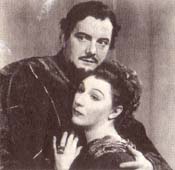 But
Anderson still wasn't finished with Macbeth. She and Evans immortalized
their Broadway performances in a Spartan production for television's Hallmark
Hall of Fame in 1954 (pictured), with Anderson winning an Emmy Award for
her performance of Lady Macbeth. Hallmark was so pleased with the results that
they returned to the material in 1962, televising a lavishly-produced version
that was shot in color on film (as opposed to the standard videotape), which
television historians often cite as the first true Made-for-TV film. Though
the Hallmark extravaganza guts the text of the play and Evans' flowery performance
in the title role now seems self-indulgent and ineffective, it was so well-received
in its own time that it was released theatrically in Europe and won five Emmy
Awards, including Anderson's second for her chilling performance as Lady Macbeth.
But
Anderson still wasn't finished with Macbeth. She and Evans immortalized
their Broadway performances in a Spartan production for television's Hallmark
Hall of Fame in 1954 (pictured), with Anderson winning an Emmy Award for
her performance of Lady Macbeth. Hallmark was so pleased with the results that
they returned to the material in 1962, televising a lavishly-produced version
that was shot in color on film (as opposed to the standard videotape), which
television historians often cite as the first true Made-for-TV film. Though
the Hallmark extravaganza guts the text of the play and Evans' flowery performance
in the title role now seems self-indulgent and ineffective, it was so well-received
in its own time that it was released theatrically in Europe and won five Emmy
Awards, including Anderson's second for her chilling performance as Lady Macbeth.